
Exosome vs PRP for Hair Loss
Exosome vs PRP for Hair Loss: A Clinical Comparison
Androgenetic alopecia (AGA) impacts approximately 50% of men by the age of 50. It affects millions of women globally, culminating in the gradual miniaturization of hair follicles, a decline in hair density, and considerable psychological distress.
Although topical minoxidil and oral finasteride remain the main therapeutic options, they require continuous administration and often yield modest results. Recently, two biologic therapies—platelet-rich plasma (PRP) and exosome therapy—have been introduced as promising regenerative alternatives for patients seeking more effective, non-surgical solutions.
For clinicians and patients evaluating exosome therapy versus platelet-rich plasma (PRP) for hair treatment, understanding the differences in mechanisms, effectiveness, recovery time, and durability is crucial. This guide provides an evidence-based comparison to support informed decision-making.
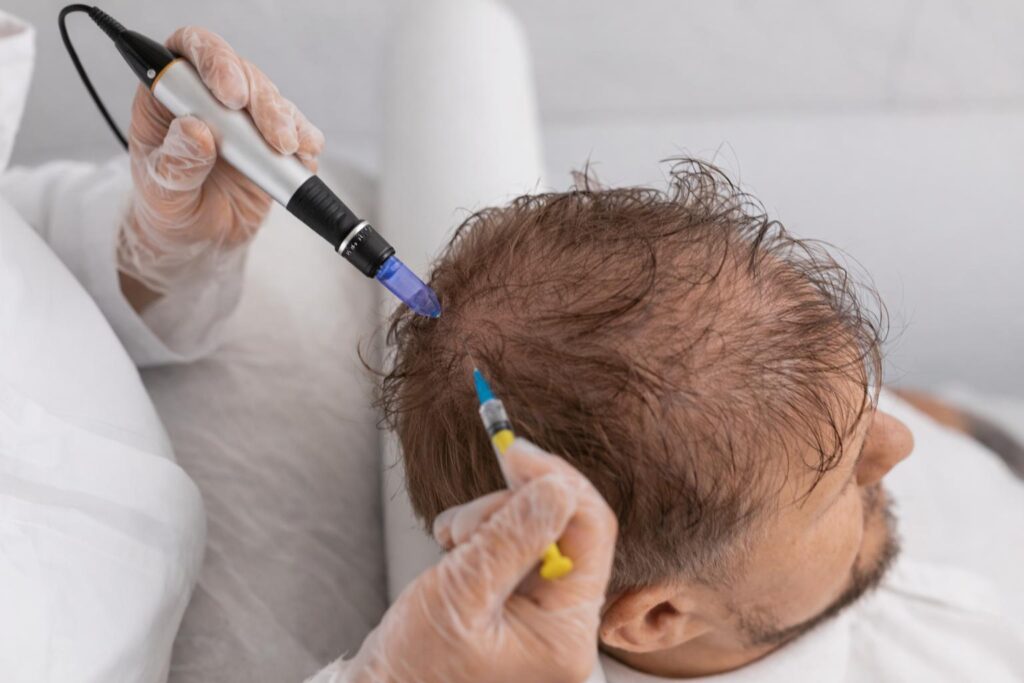
Mechanism of Action: How Each Treatment Works
PRP for Hair Restoration
PRP is derived from the patient’s own blood. A modest volume is procured, centrifuged to concentrate platelets, and then administered into the scalp. Platelets encompass a range of growth factors (including PDGF, VEGF, TGF-β1, and IGF-1) that stimulate quiescent hair follicles, prolong the anagen (growth) phase, and improve sanguineous flow to the scalp.
A 2025 systematic review and meta-analysis of 43 randomized controlled trials (1,877 participants) found that activated PRP increased hair density compared with placebo and that PRP reduced hair loss, supporting it as a relatively safe and effective option for alopecia. However, PRP did not significantly affect hair thickness, and the authors noted heterogeneity in study designs and PRP preparation methods.
Exosome Therapy for Hair Loss
Exosomes are nanoscale extracellular vesicles ranging from 30 to 150 nanometers in size that are secreted by mesenchymal stem cells (MSCs). They encompass a diverse array of bioactive molecules, including growth factors, proteins, lipids, mRNA, and microRNAs (miRNAs), which facilitate intercellular communication and directly target hair follicle stem cells.
In contrast to PRP, exosome therapy does not require a blood draw or injection. Instead, professionally formulated topical exosome products, such as Elevexo™, are applied to the scalp, often after microneedling to enhance penetration.
Laboratory and animal (preclinical) research suggests that exosomes may act through several pathways, although these mechanisms have not been confirmed in human clinical trials:
- Delivering growth factors directly to dormant follicles
- Modulating inflammation by reducing pro-inflammatory cytokines such as TNF-α, IL-6, and IL-1β
- Promoting angiogenesis via the PI3K/Akt-VEGFA axis, restoring the follicular vascular niche
- Activating hair follicle stem cells through Wnt/β-catenin, Shh, and HIF-1α signaling pathways
A 2025 systematic review of 11 clinical studies, including 2 randomized controlled trials (RCTs), concluded that mesenchymal stem cell (MSC)-derived exosomes appear to be a safe and efficacious treatment for androgenetic alopecia (AGA) and other forms of alopecia, with high patient satisfaction.
Clinical Evidence: Head-to-Head Comparisons
Randomized Controlled Trial: Salmon Tissue-Derived Exosomes vs PRP
A prospective randomized controlled trial published in 2026 (Olisova et al., Russian Journal of Skin and Venereal Diseases) enrolled 40 participants with mild-to-moderate androgenetic alopecia (AGA). It compared a salmon tissue-derived exosome product (ersaless InfoSys II), given in four biweekly sessions, with platelet-rich plasma (PRP) given in five biweekly sessions. At the assessment 12 weeks after the last procedure, the exosome group showed statistically significantly greater improvement than the PRP group on most measured parameters. This study evaluated a salmon-derived exosome product, not Elevexo™. Its results cannot be applied to Elevexo™ or to exosome products in general.
Reported findings from one 2026 RCT: salmon tissue-derived exosomes (ersaless InfoSys II) vs PRP; n=40; measured 12 weeks after the last session.
Parameter | Salmon-Exosome Group (study) | PRP Group | Difference (p-value) |
Hair density increase | +44.4 hairs/cm² | +26.3 hairs/cm² | +18.1 (p<0.001) |
Vellus hair reduction | –37.0% | –21.2% | (p=0.003) |
Terminal/vellus ratio | 2.4 → 9.7 | → 4.8 | (p=0.001) |
Anagen proportion increase | +36.4% | +23.4% | (p=0.002) |
Mean hair diameter increase | +22.4μm | +12.4μm | (p<0.001) |
In this single study, the salmon-exosome group showed statistically significant advantages over PRP on most measured parameters, with fewer sessions. Limitations include a small sample (40 participants), evaluation of one specific product, short follow-up (12 weeks after the last session), and enrollment limited to mild-to-moderate AGA. Independent replication and longer-term studies are needed.
General Feature Comparison
Feature | Exosome Therapy | PRP Treatment |
Source | Lab-cultured mesenchymal stem cells | Patient’s own blood |
Growth factor concentration | Varies by product and manufacturing process | Varies by patient and preparation method |
Procedure time | 30-45 minutes | 60-90 minutes (plus blood draw) |
Pain level | Minimal | Mild to moderate |
Recovery time | Immediate | 1-2 days |
Results timeline | Not established in comparative studies; varies by product and protocol | Varies by protocol; studies commonly assess at 3–6 months |
Number of sessions | Varies by product and protocol (4 sessions in the 2026 RCT) | Commonly 3 monthly sessions, often with maintenance (5 in the 2026 RCT) |
Longevity of results | Not established by long-term studies | Not established by long-term studies |
Consistency | Depends on product manufacturing and quality control | Varies with patient biology and preparation system |
FDA-compliant cosmetic status | Yes (EleveXo™ and Ascellos®) | Not applicable |
Longevity and Maintenance
Longevity is a key consideration when comparing exosome and PRP hair treatments. How long results last has not been established for either treatment in head-to-head studies. Published exosome trials have generally reported short follow-up periods (for example, 12 weeks after the last session in the 2026 salmon-exosome RCT), and reviews note that PRP studies are also limited by short follow-up. Both treatments are commonly paired with periodic maintenance sessions.
Clinical Suitability
Patient Profile | Options to Discuss | Rationale |
Early-stage hair thinning | Exosome therapy or PRP | Comparative evidence is limited; the choice depends on clinical assessment and patient preference |
Moderate-to-severe AGA | PRP or exosome therapy, often alongside standard treatments | No study has shown either is superior in advanced cases; the 2026 RCT enrolled only mild-to-moderate AGA |
Patients with poor blood quality (anemia, etc.) | Non-autologous options, such as exosome therapy, may be discussed | Does not depend on the patient’s own blood quality |
Budget-sensitive patients | Compare total treatment costs | Costs vary by clinic, product and number of sessions |
Patients preferring autologous treatment | PRP | Uses the patient’s own biological material |
Can Exosome and PRP Treatments Be Combined?
Some clinics use PRP and exosome therapy together. The rationale is that PRP supplies platelet-derived growth factors while exosomes carry a different set of signaling molecules. However, there is currently limited controlled clinical evidence on whether combining them improves results, and reviews of regenerative therapies have generally excluded combination treatments.
Frequently Asked Questions
Are exosomes better than PRP for hair loss?
Current evidence does not establish that exosomes are better than PRP in general. One 2026 randomized controlled trial (40 participants with mild-to-moderate AGA) found that a salmon tissue-derived exosome product (ersaless InfoSys II) produced greater improvements than PRP in hair density, vellus hair reduction, terminal-to-vellus ratio, anagen proportion and hair diameter, measured 12 weeks after the last session, with fewer sessions. This was a single small study of one product with short follow-up, and its results do not apply to other exosome products, including Elevexo™. PRP has a larger evidence base, including a 2025 meta-analysis of 43 RCTs. More head-to-head research is needed.
How long do exosome hair treatment results last?
How long exosome hair treatment results last has not been established. Published clinical studies have generally used short follow-up periods. Some clinics offer periodic maintenance sessions, but their long-term effect has not been established in clinical studies.
Is exosome therapy painful?
Most patients experience little discomfort, particularly when the procedure is combined with anesthetic cream or microneedling. There is no pain linked to the injections.
Who is a good candidate for exosome hair therapy?
Men and women with early to moderate androgenetic alopecia (AGA), stress-related hair loss (telogen effluvium), or who have not responded well to minoxidil or finasteride might consider exosome therapy. A qualified healthcare professional can help determine whether exosome therapy, PRP or another option is appropriate.
Ready to offer advanced exosome hair restoration?
EleveXo™ offers professionally developed MSC-derived exosome products for hair and skin regeneration. Every batch is manufactured in accordance with cGMP and cGTP standards and undergoes thorough quality control. Partner with our licensed clinics and medical distributors to provide science-based regenerative treatments to your patients.
Disclaimer: This content is for educational and informational use only, based on published scientific literature. EleveXo™ is a cosmetic topical that complies with FDA regulations. It is not meant to diagnose, treat, cure, or prevent any medical conditions. Always seek advice from a qualified healthcare professional for medical guidance.